Epipelic Diatom Communities as Bioindicators of Environmental Conditions in Karangjahe Coastal Sediments, Central Java
DOI:
https://doi.org/10.51264/inajl.v7i1.132Keywords:
Benthic diatoms, Bioindicator, Central Java, Epipelic diatom, Water qualityAbstract
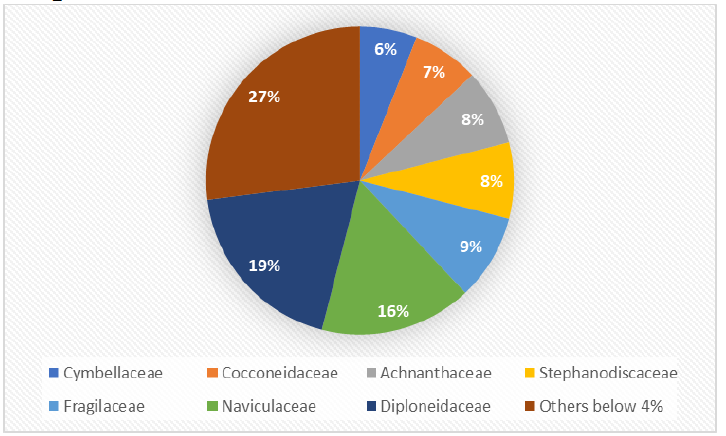
Coastal ecosystems at Karangjahe Beach, Rembang, are under increasing pressure from tourism activities and terrestrial runoff. This study aims to analyze epipelic diatom communities as bioindicators of the local environmental health. Sampling was conducted on September 12, 2024, across four stations with distinct environmental characteristics. The results identified a diatom composition comprising 24 families, 45 genera, and 79 species, with a total cumulative abundance of 20,535 ind.gr-1. Station KJ.1, located at an old pier, recorded the highest abundance, while station KJ.2, a recreational playground area, exhibited the lowest. The Shannon-Wiener Diversity Index (H’) ranged from 1.5 to 3, indicating moderate community stability. Physicochemical analysis revealed that dissolved oxygen (DO) levels at all sites (2.8–3.6 mg/L) fell below the regulatory minimum of 5 mg/L, indicating environmental stress. This study concludes that the structure of the epipelic diatom community at Karangjahe Beach is significantly shaped by a combination of natural factors, including salinity and substrate type, as well as anthropogenic influences from tourism and aquaculture, with the bioindicator signal primarily driven by key taxa such as Pseudoplanothidium delicatulum and Cyclotella meneghiniana.
References
Al Falah, M. H. A., Soeprobowati, T. R., Hadiyanto, H., Rahim, A., [authors omitted in your list: add all names], & Heijnis, H. (2025). Analysis of the suitability of tropical epipelic diatoms to the Omnidia Diatom Database and its ability to determine the present condition in Tuntang River downstream, Demak, Indonesia. Evergreen, 12(1), 104-115.
Anu, K., Henna, P. K., Sneha, V. K., Busheera, P., Muhammed, J., & Augustine, A. (2024). Mangroves in environmental engineering: Harnessing the multifunctional potential of nature’s coastal architects for sustainable ecosystem management. Results in Engineering, 21, Article 101765. https://doi.org/10.1016/j.rineng.2024.101765
Astrini, A. D. R., Yusuf, M., & Santoso, A. (2014). Kondisi perairan terhadap struktur komunitas makrozoobenthos di muara sungai Karanganyar dan Tapak, Kecamatan Tugu, Semarang. Journal of Marine Research, 3(1), 27–36.
Barsanti, L., & Gualtieri, P. (2006). Algae: Anatomy, biochemistry, and biotechnology. Taylor & Francis.
Blanco, S., Muñoz-López, C. L., & Rivera-Rondón, C. A. (2020). Nupela eremica sp. nov. (Bacillariophyta, Naviculaceae) from a páramo lake in the Colombian Andes. Phytotaxa, 455(4), 295–300.
Carpenter, S. R. (2005). Eutrophication of aquatic ecosystems: Bistability and soil phosphorus. Proceedings of the National Academy of Sciences, 102(29), 10002–10005. https://doi.org/10.1073/pnas.0503959102
Chevalier, M., Davis, B. A. S., Heiri, O., Seppä, H., Chase, B. M., Gajewski, K., Lacourse, T., Telford, R. J., Finsinger, W., Guiot, J., Kühl, N., Maezumi, S. Y., Tipton, J. R., Carter, V. A., Brussel, T., Phelps, L. N., Dawson, A., Zanon, M., Vallé, F., … Kupriyanov, D. (2020). Pollen-based climate reconstruction techniques for late Quaternary studies. Earth-Science Reviews, 210, Article 103384. https://doi.org/10.1016/j.earscirev.2020.103384
Choirul, M., Soeprobowati, T. R., Khotimperwati, L., Jumari, J., Baskoro, K., Al Falah, M. H. A., & Dalem, A. A. G. R. (2025). Diatoms as bioindicators of ecological stability in the mangrove ecosystem of Benoa Bay, Bali. BIO Web of Conferences, 196, Article 02005.
Choirun, A., Sari, S. H. J., & Iranawati, F. (2015). Identifikasi fitoplankton spesies harmful algae bloom (HAB) saat kondisi pasang di perairan pesisir Brondong, Lamongan, Jawa Timur. Jurnal Ilmu Kelautan dan Perikanan, 25(2), 58–66.
Costa, L. F., Wetzel, C. E., Ector, L., & Bicudo, D. C. (2020). Freshwater Cocconeis species (Bacillariophyceae) from Southeastern Brazil, and description of C. amerieuglypta sp. nov. Botany Letters, 167(1), 15–31.
Facca, C., Bernardi Aubry, F., Socal, G., Ponis, E., Acri, F., Bianchi, F., Giovanardi, F., & Sfriso, A. (2014). Description of a multimetric phytoplankton index (MPI) for the assessment of transitional waters. Marine Pollution Bulletin, 79(1–2), 145–154.
Fitriyah, Y., Sulardiono, B., & Widyorini, N. (2016). Struktur komunitas diatom di perairan tandon air untuk tambak garam di Desa Kedung Mutih Kecamatan Wedung, Demak. Management of Aquatic Resources Journal (MAQUARES), 5(2), 11–16.
Gell, P. A., Sonneman, J. A., Reid, M. A., Illman, M. A., & Sincock, A. J. (1999). An illustrated key to common diatom genera from southern Australia. Cooperative Research Centre for Freshwater Ecology.
Handayani, D. R., Armid, & Emiyarti. (2016). Hubungan kandungan nutrien dalam substrat terhadap kepadatan lamun di perairan Desa Lalowaru Kecamatan Moramo Utara. Sapa Laut, 1(2), 42–53.
Hevia-Orube, J., Orive, E., David, H., Díez, A., Laza-Martínez, A., Miguel, I., & Seoane, S. (2016). Molecular and morphological analyses of solitary forms of brackish Thalassiosiroid diatoms (Coscinodiscophyceae), with emphasis on their phenotypic plasticity. European Journal of Phycology, 51(1), 11–30.
Kordi, M. G. H. K. (1996). Parameter kualitas air. Karya Anda.
Krammer, K., & Lange-Bertalot, H. (2004). Bacillariophyceae: Vol. 4. Achnanthaceae, kritische Ergänzungen zu Navicula (Lineolatae) und Gomphonema, Gesamtliteraturverzeichnis Teil 1–4 (2nd rev. ed.). In H. Ettl, J. Gerloff, H. Heynig, & D. Mollenhauer (Eds.), Süßwasserflora von Mitteleuropa (Vol. 2). Spektrum Akademischer Verlag.
Kulikovskiy, M., Genkal, S., Maltsev, Y., [add remaining authors], & Kociolek, J. P. (2022). Resurrection of the diatom genus Stephanocyclus (Coscinodiscophyceae: Stephanodiscaceae) on the basis of an integrated molecular and morphological approach. Fottea, 22(2), 181–191.
Muhammad, F., Hidayat, J. W., & Wiryani, E. (2020). Keanekaragaman avifauna sebagai potensi ekowisata di Pantai Karangjahe, Kabupaten Rembang. Jurnal Akademika Biologi, 9(1), 32–37.
Murhandini, I. K., Hidayat, J. W., & Muhammad, F. (2022). Struktur komunitas ikan di Pantai Karang Jahe Rembang. Bioma: Berkala Ilmiah Biologi, 24(1), 80–89.
Nontji, A. (2007). Laut Nusantara. Djambatan.
Pienitz, R., Smol, J. P., Last, W. M., Leavitt, P. R., & Cumming, B. F. (2000). Multi-proxy Holocene palaeoclimatic record from a saline lake in the Canadian Subarctic. The Holocene, 10(6), 673–686.
Potapova, M. (2014). Diatoms of Bering Island, Kamchatka, Russia. Nova Hedwigia, Beiheft 143, 63–102.
Potapova, M. G., Ponader, K. C., Lowe, R. L., Clason, T. A., & Bahls, L. L. (2003). Small-celled Nupela species from North America. Diatom Research, 18(2), 293–306.
Rodríguez-Miret, X., Felip, M., Pelletier, E., & Catalan, J. (2025). Molecular complexity of the differential growth of freshwater diatoms along pH gradients. ISME Communications, 5(1), Article ycaf078. https://doi.org/10.1093/ismeco/ycaf078
Rühland, K., Priesnitz, A., & Smol, J. P. (2003). Paleolimnological evidence from diatoms for recent environmental changes in 50 lakes across Canadian Arctic treeline. Arctic, Antarctic, and Alpine Research, 35(1), 110–123.
Sari, K., Soeprobowati, T. R., Jumari, J., Hariyati, R., & Miller, J. R. (2021). Trace metals and diatom stratigraphy along the sill between lakes Telaga Warna and Telaga Pengilon, Dieng, Central Java, Indonesia. Sustainability, 13(7), Article 3821. https://doi.org/10.3390/su13073821
Sidabutar, E. A., Sartimbul, A., & Handayani, M. (2019). Distribusi suhu, salinitas dan oksigen terlarut terhadap kedalaman di perairan Teluk Prigi Kabupaten Trenggalek. Journal of Fisheries and Marine Research, 3(1), 46–52.
Sitindoan, B. (2020). Effect of particle sizes and content of organic matter sediment on epipelic diatom abundance in Bayur Bay waters of West Sumatera. Asian Journal of Aquatic Sciences, 3(1), 49–59.
Soeprobowati, T. R., Tandjung, S. D., Sutikno, S., Hadisusanto, S., & Gell, P. (2016). The minimum number of valves for diatoms identification in Rawapening Lake, Central Java. Biotropia, 23(2), 97–100.
Sonneman, J., Sincock, A., Fluin, J., Reid, M., Newall, P., Tibby, J., & Gell, P. (2000). An illustrated guide to common stream diatom species from temperate Australia (Identification Guide Series No. 33). Murray-Darling Freshwater Research Centre; Cooperative Research Centre for Freshwater Ecology.
Sudinno, D., Jubaedah, I., & Anas, P. (2015). Kualitas air dan komunitas plankton pada tambak pesisir Kabupaten Subang, Jawa Barat. Jurnal Penyuluhan Perikanan dan Kelautan, 9(1), 13–28.
Supono. (2016). Analisis indeks true diversities diatom epipelik tambak udang dengan tekstur tanah yang berbeda. Maspari Journal, 8(1), 31–38.
Talgatti, D., Wetzel, C. E., Morales, E. A., Ector, L., & Torgan, L. C. (2014). Transfer of Fragilaria atomus Hust. to the genus Stauroforma (Bacillariophyta) based on observation of type and newly collected material. Phytotaxa, 158(1), 43–56.
Tan, X., Zhang, Q., Burford, M. A., Sheldon, F., & Bunn, S. E. (2017). Benthic diatom based indices for water quality assessment in two subtropical streams. Frontiers in Microbiology, 8, Article 2047.
Taylor, J. C., Harding, W. R., & Archibald, C. G. M. (2007). An illustrated guide to some common diatom species from South Africa (WRC Report No. TT 282/07). Water Research Commission.
Van de Vijver, B., Wetzel, C. E., & Ector, L. (2018). Analysis of the type material of Planothidium delicatulum (Bacillariophyta) with the description of two new Planothidium species from the sub-Antarctic Region. Fottea, 18(2), 200–211.
Xu, M., Wang, R., Dong, X., Zhang, Q., & Yang, X. (2022). Intensive human impacts drive the declines in heterogeneity of diatom communities in shallow lakes of East China. Ecological Indicators, 140, Article 108994. https://doi.org/10.1016/j.ecolind.2022.108994
Yu, P., You, Q. M., Kociolek, J. P., Lowe, R., & Wang, Q. X. (2017). Nupela major sp. nov., a new diatom species from Maolan Nature Reserve, central-south of China. Phytotaxa, 311(3), 245–254.
Zalat, A. A., & Al-Wosabi, M. (2010). Preliminary investigation of diatom taxa distribution in recent surface sediments of Socotra Island (Yemen), Indian Ocean. Egyptian Journal of Paleontology, 10, 49–60.
Zong, Y., & Hassan, K. B. (2004). Diatom assemblages from two mangrove tidal flats in Peninsular Malaysia. Diatom Research, 19(2), 329–344.
Downloads
Published
Issue
Section
License
Copyright (c) 2026 Mirza Hanif Al Falah, Muhammad Ilham Jasir, Tri Retnaningsih Soeprobowati, Jumari Jumari, ?ukasz Kruszewski

This work is licensed under a Creative Commons Attribution 4.0 International License.