Analysis of Mangrove Carbon Economic Potential and Community Based Mangrove Management in Mojo Village, Pemalang Regency
DOI:
https://doi.org/10.51264/inajl.v7i1.98Keywords:
Carbon markets, Coastal resilience, Environmental governance, Local livelihoods, Participatory conservationAbstract
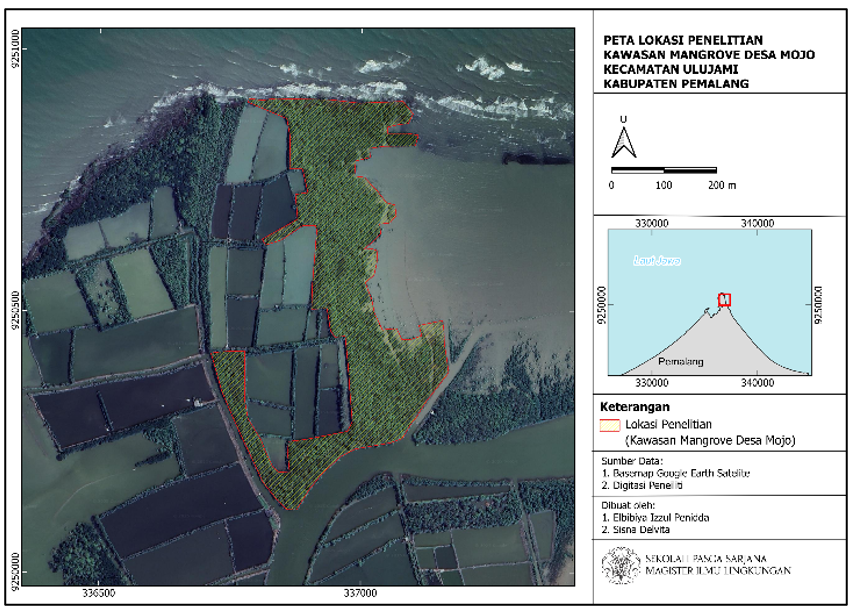
Mangrove forests are vital for maintaining coastal ecosystem balance and mitigating climate change through blue carbon storage. This study present a novel integration of blue carbon economic valuation and community-Based mangrove Management (CBMM) assessment at the village scale, using mojo village, Indonesia as a case study. Mojo village was chosen as the research location because of the carbon potential that Mojo village has to be developed using the CBMM concept. A mixed-method approach combined secondary data analysis of mangrove carbon stocks with semi-structured interviews involving key members of the Pelita Bahari community group. The Mojo Village mangrove ecosystem demonstrated substantial blue carbon value, estimated between IDR 34.66 million and IDR 199.78 million per hectare under different carbon market scenarios, indicating substantial mitigation and financial potential. CBMM analysis reveals that strong local participation and institutional legitimacy support conservation outcomes; however, limited technical capacity, external dependence, and weak monitoring constrain readiness for carbon market participation. Analytically, the findings demonstrate that carbon valuation alone is insufficient without parallel governance strengthening. Community-based mangrove management supports the sustainability of coastal ecosystems and contributes to community welfare through the economic valorization of blue carbon. Beyond local benefits, this study contributes to the global blue carbon discourse by illustrating how village-level community management can inform scalable, socially inclusive pathways for integrating mangroves into national climate strategies, carbon markets, and international mitigation frameworks under the Paris Agreement.
References
Adger, W. N. (2003). Social capital, collective action, and adaptation to climate change. Economic Geography, 79(4), 387–404. https://doi.org/10.1111/j.1944-8287.2003.tb00220.x
Adhikari, B., & Goldey, P. (2010). Social capital and its “downside”: The impact on sustainability of induced community-based organizations in Nepal. World Development, 38(2), 184–194. https://doi.org/10.1016/j.worlddev.2009.10.012
Agrawal, A., & Gibson, C. C. (1999). Enchantment and disenchantment: The role of community in natural resource conservation. World Development, 27(4), 629–649. https://doi.org/10.1016/S0305-750X(98)00161-2
Alongi, D. M. (2014). Carbon cycling and storage in mangrove forests. Annual Review of Marine Science, 6, 195–219. https://doi.org/10.1146/annurev-marine-010213-135020
Armitage, D. (2005). Adaptive capacity and community-based natural resource management. Environmental Management, 35(6), 703–715. https://doi.org/10.1007/s00267-004-0076-z
Armitage, D., Berkes, F., & Doubleday, N. (Eds.). (2009). Adaptive co-management: Collaboration, learning, and multi-level governance. UBC Press.
Astiani, D., Curran, L. M., Sabiham, S., & Setiawan, Y. (2024). Community-based mangrove rehabilitation enhances biomass and carbon stocks in Singkawang, West Kalimantan. Journal of Tropical Forest Science, 36(2), 211–223. https://doi.org/10.26525/jtfs2024.36.2
Barbier, E. B. (2016). The protective service of mangrove ecosystems: A review of valuation methods. Marine Pollution Bulletin, 109(2), 676–681. https://doi.org/10.1016/j.marpolbul.2016.01.033
Barbier, E. B., Hacker, S. D., Kennedy, C., Koch, E. W., Stier, A. C., & Silliman, B. R. (2011). The value of estuarine and coastal ecosystem services. Ecological Monographs, 81(2), 169–193. https://doi.org/10.1890/10-1510.1
Berkes, F. (2004). Rethinking community-based conservation. Conservation Biology, 18(3), 621–630. https://doi.org/10.1111/j.1523-1739.2004.00077.x
Braun, V., & Clarke, V. (2006). Using thematic analysis in psychology. Qualitative Research in Psychology, 3(2), 77–101. https://doi.org/10.1191/1478088706qp063oa
Cleaver, F. (2002). Reinventing institutions: Bricolage and the social embeddedness of natural resource management. The European Journal of Development Research, 14(2), 11–30. https://doi.org/10.1080/714000425
Creswell, J. W., & Poth, C. N. (2018). Qualitative inquiry and research design: Choosing among five approaches (4th ed.). SAGE Publications.
Dahdouh-Guebas, F., Jayatissa, L. P., Di Nitto, D., Bosire, J. O., Seen, D. L., & Koedam, N. (2005). How effective were mangroves as a defense against the recent tsunami? Current Biology, 15(12), R443–R447. https://doi.org/10.1016/j.cub.2005.06.008
Damastuti, E., Groot de, R., Debrot. A. O., & Silvius. M. J (2022). Effectiveness of community-based mangrove management for biodiversity conservation: A case study from Central Java, Indonesia. Trees, Forests and People 7 (2022) 100202. https://doi.org/10.1016/j.tfp.2022.100202
Deciawarman, E., Putri, P.L.W., Irawan, D., Irviansyah, A., Darmin., & Rahmawati. (2025). Menakar Peran Serta Masyarakat dalam Pelestarian Mangrove: Analisis Faktor Pendukung dan Tantangannya di Kalimantan Timur. Ulin - J Hut Trop 9 (2) : 487- 502. http://dx.doi.org/10.32522/ujht.v9i2.23423
Dinda, A. A., Hidayat, R., & Siregar, A. (2020). Peran masyarakat dalam rehabilitasi mangrove di Kabupaten Langkat, Sumatera Utara. Jurnal Perikanan dan Kelautan Tropis, 21(2), 123–133. https://doi.org/10.35800/jpkt.v21i2.321
Donato, D. C., Kauffman, J. B., Murdiyarso, D., Kurnianto, S., Stidham, M., & Kanninen, M. (2011). Mangroves among the most carbon-rich forests in the tropics. Nature Geoscience, 4(5), 293–297. https://doi.org/10.1038/ngeo1123
Duarte, C. M., Losada, I. J., Hendriks, I. E., Mazarrasa, I., & Marbà, N. (2013). The role of coastal plant communities for climate change mitigation and adaptation. Nature Climate Change, 3(11), 961–968. https://doi.org/10.1038/nclimate1970
Dulyakasem, R., Brooks, C., & Lehnert, S. L. (2025). Community-based natural resource management in coastal communities: The contribution of mangroves to household livelihoods in southern Thailand. Environmental Development. 57 (2026) 101340. https://doi.org/10.1016/j.envdev.2025.101340
Environmental Defense Fund. (2017). The social cost of carbon. Environmental Defense Fund. Retrieved from https://www.edf.org/true-cost-carbon-pollution
Fabricius, C., Folke, C., Cundill, G., & Schultz, L. (2007). Powerless spectators, coping actors, and adaptive co-managers: A synthesis of the role of communities in ecosystem management. Ecology and Society, 12(1), 29. https://doi.org/10.5751/ES-02072-120129
Folke, C., Carpenter, S., Walker, B., Scheffer, M., Chapin, T., & Rockström, J. (2010). Resilience thinking: Integrating resilience, adaptability and transformability. Ecology and Society, 15(4), 20. https://doi.org/10.5751/ES-03610-150420
Folke, C., Hahn, T., Olsson, P., & Norberg, J. (2005). Adaptive governance of social-ecological systems. Annual Review of Environment and Resources, 30(1), 441–473. https://doi.org/10.1146/annurev.energy.30.050504.144511
Friess, D. A., Rogers, K., Lovelock, C. E., Krauss, K. W., Hamilton, S. E., Lee, S. Y., Lucas, R., Primavera, J., Rajkaran, A., & Shi, S. (2019). The state of the world’s mangrove forests: Past, present, and future. Annual Review of Environment and Resources, 44(1), 89–115. https://doi.org/10.1146/annurev-environ-101718-033302
Giri, C., Ochieng, E., Tieszen, L. L., Zhu, Z., Singh, A., Loveland, T., Masek, J., & Duke, N. (2011). Status and distribution of mangrove forests of the world using earth observation satellite data. Global Ecology and Biogeography, 20(1), 154–159. https://doi.org/10.1111/j.1466-8238.2010.00584.x
Goldstein, A., Turner, W. R., Spawn, S. A., et al. (2020). Protecting irrecoverable carbon in Earth’s ecosystems. Nature Climate Change, 10, 287–295.
Griscom, B. W., Adams, J., Ellis, P. W., et al. (2017). Natural climate solutions. Proceedings of the National Academy of Sciences, 114(44), 11645–11650.
Haryati, A., Fikriyya, N., & Prihatiningsih, I. (2024). Estimation of organic carbon stocks in the mangrove ecosystem in Mojo Village, Ulujami District, Pemalang. Jurnal Ilmu dan Teknologi Kelautan Tropis, 16(1), 75–88. https://doi.org/10.29244/jitkt.v16i1.51920
Marriot, S. E., Cox, C. Amolo, R. C. Apistar, D. Mancao, R.H. & Mutsert K. D. (2021). Implications of Community-Based Management of Marine Reserves in the Philippines for Reef Fish Communities and Biodiversity. Frontiers in Marine Science. https://doi: 10.3389/fmars.2021.731675
IPCC. (2006). 2006 IPCC guidelines for national greenhouse gas inventories. Intergovernmental Panel on Climate Change. Retrieved from https://www.ipcc-nggip.iges.or.jp/public/2006gl/
IPCC. (2014). Climate Change 2014: Synthesis Report. Contribution of Working Groups I, II and III to the Fifth Assessment Report of the Intergovernmental Panel on Climate Change. Core Writing Team, Pachauri, R. K., & Meyer, L. A. (Eds.). IPCC. https://www.ipcc.ch/report/ar5/syr/
Kepel, T. L., Yonvitner, & Adrianto, L. (2017). Mekanisme pasar karbon untuk pengelolaan ekosistem pesisir dan laut. Jurnal Kebijakan Perikanan Indonesia, 9(2), 95–107. https://doi.org/10.15578/jkpi.9.2.2017.95-107
Muradian, R., Corbera, E., Pascual, U., Kosoy, N., & May, P. H. (2010). Reconciling theory and practice: An alternative conceptual framework for understanding payments for environmental services. Ecological Economics, 69(6), 1202–1208.
Murdiyarso, D., Purbopuspito, J., Kauffman, J. B., Warren, M., Sasmito, S. D., Donato, D., ... & Kurnianto, S. (2015). The potential of Indonesian mangrove forests for global climate change mitigation. Nature Climate Change, 5(12), 1089–1092. https://doi.org/10.1038/nclimate2734
Nasution, I., & Wijaya, A. (2024). Effectiveness of community-based mangrove management in protecting coastal areas of Demak, Central Java. Ocean and Coastal Management, 245, 106765. https://doi.org/10.1016/j.ocecoaman.2024.106765
Newell, R. G., Pizer, W. A., & Raimi, D. (2014). Carbon market design, stability, and reform. Energy Policy, 75, 14–22.
Ostrom, E. (1990). Governing the commons: The evolution of institutions for collective action. Cambridge University Press.
Patton, M. Q. (2015). Qualitative research & evaluation methods (4th ed.). SAGE Publications.
Pribadi, R., Dharmawan, A. H., & Saharuddin, S. (2017). Social capital and sustainability of community-based mangrove management in Demak, Indonesia. Komunitas: International Journal of Indonesian Society and Culture, 9(1), 68–78. https://doi.org/10.15294/komunitas.v9i1.9050
Primavera, J. H. (2000). Development and conservation of Philippine mangroves: Institutional issues. Ecological Economics, 35(1), 91–106. https://doi.org/10.1016/S0921-8009(00)00170-1
Puspitasari, R., Yulianda, F., Bengen, D. G., & Fahrudin, A. (2020). Social capital and collective action in community-based mangrove management in Indonesia. IOP Conference Series: Earth and Environmental Science, 404, 012041. https://doi.org/10.1088/1755-1315/404/1/012041
Putriani, R. B., Hasani, Q., Yudha, I. G., Diantari, R., Yuliana, D., Caesario, R., Reza, M., & Julian, D. (2024). Pengelolaan taman wisata laut berbasis Community Based Management (CBM). Jurnal Mina Sains, 10(1): 34-44.
Rahmawati, R., Supriatna, J., & Prasetyo, L. B. (2022). Corporate social responsibility and community participation in mangrove ecosystem conservation in Indonesia. Journal of Environmental Management, 301, 113787. https://doi.org/10.1016/j.jenvman.2021.113787
Sathiyamoorthy, S. Sakurai, Takeshi. (2024). Effectiveness of community participation in Mangrove
restoration: the evidence from northern Sri Lanka. Environmental Economics and Policy Studies. 26:759–779. https://doi.org/10.1007/s10018-024-00397-1
Siikamäki, J., Sanchirico, J. N., & Jardine, S. L. (2012). Global economic potential for reducing carbon dioxide emissions from mangrove loss. Proceedings of the National Academy of Sciences, 109(36), 14369–14374. https://doi.org/10.1073/pnas.1200519109
Susanto, H. A., Suryono, A. F., & Prasetyo, L. B. (2022). Community-based mangrove rehabilitation and livelihood diversification in coastal Java, Indonesia. Ocean & Coastal Management, 224, 106194. https://doi.org/10.1016/j.ocecoaman.2022.106194
Walters, B. B. (2004). Local management of mangrove forests in the Philippines: Successful conservation or efficient resource exploitation? Human Ecology, 32(2), 177–195. https://doi.org/10.1023/B:HUEC.0000019762.36462.9f
Walters, B. B., Rönnbäck, P., Kovacs, J. M., Crona, B., Hussain, S. A., Badola, R., Primavera, J. H., Barbier, E., & Dahdouh-Guebas, F. (2008). Ethnobiology, socio-economics and management of mangrove forests: A review. Aquatic Botany, 89(2), 220–236. https://doi.org/10.1016/j.aquabot.2008.02.009
Wunder, S. (2015). Revisiting the concept of payments for environmental services. Ecological Economics, 117, 234–243. https://doi.org/10.1016/j.ecolecon.2014.08.016
Downloads
Published
Issue
Section
License
Copyright (c) 2026 Sisna Delvita, Elbibiya Izzul Penidda, Emilya Nurjani

This work is licensed under a Creative Commons Attribution 4.0 International License.